
Designing the experience for multi-cloud cost management

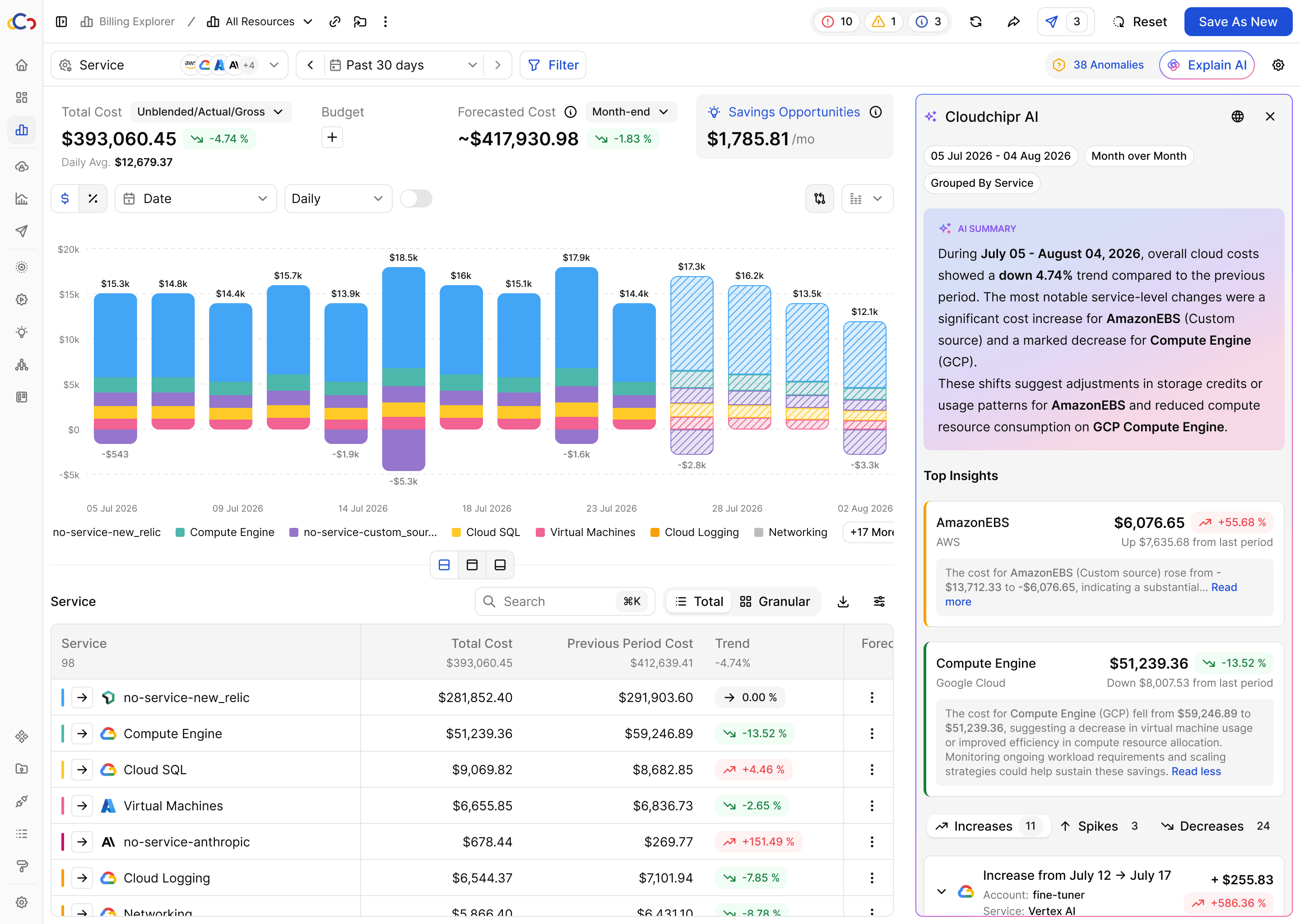
At a glance
The problem
As businesses scale, cloud costs inevitably rise, while fragmented billing data makes every increase difficult to explain and investigate.
What I did
I led the end-to-end product design, shaping the product from early customer problems through strategy, workflows, and delivery.
The outcome
One workspace where a cost change leads to its cause, owner, and next action without leaving the product.
15+
Enterprise contracts where UX was named a deciding factor
25+
Cloud and SaaS providers unified in one place
300+
Customer requests solved
Role
Founding Product Designer
I owned product design from customer insight to launch. With no dedicated PM, I worked directly with founders, engineers, customers, and marketing while managing two designers.
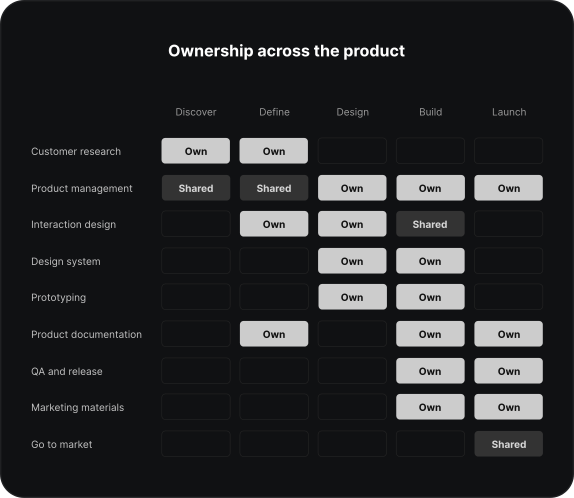
| Activity | Discover | Define | Design | Build | Launch |
|---|---|---|---|---|---|
| Customer research | Own | Own | Not involved | Not involved | Not involved |
| Product management | Shared | Shared | Own | Own | Own |
| Interaction design | Not involved | Own | Own | Shared | Not involved |
| Design system | Not involved | Not involved | Own | Own | Not involved |
| Prototyping | Not involved | Not involved | Own | Own | Not involved |
| Product documentation | Not involved | Own | Not involved | Own | Own |
| QA and release | Not involved | Not involved | Not involved | Own | Own |
| Marketing materials | Not involved | Not involved | Not involved | Own | Own |
| Go to market | Not involved | Not involved | Not involved | Not involved | Shared |
Challenge
Scale design, learn Cloud domain, own product decisions, and maintain delivery speed.
Solution
Introduced lightweight processes, built domain expertise, and established clear ownership and delivery standards.
Before
Reactive delivery
- No dedicated PM or established product process
- Customer requests moved directly into delivery based on rough sketches.
- Limited discovery and testing
- Inconsistent design files and handoff

Lightweight changes
Structure without slowing down
- Research and discovery
- Grooming and focused brainstorming
- Baseline requirements with space to explore
- Clear design process
After
More intentional delivery
- Clearer problems and requirements
- More informed design decisions
- Consistent files, reviews, and handoff
- A shared quality bar for the team
Design Process
Turning customer evidence into product decisions
We turned customer research and product data into product principles and prototypes, then refined them with customers, founders, and engineers.
- 01
Gather Data
- Interviews and demos
- Feature requests
- Analytics and real-world cloud data
- 02
Identify patterns
- Persona needs
- Recurring problems
- Workflow gaps
- 03
Prototype
- End-to-end flows
- Interaction concepts
- Clickable prototypes
- 04
Test and validate
- Customer feedback
- Team reviews
- Live product behavior
In an early-stage startup, not every decision has time for a full validation cycle. Sometimes you need to use the strongest available signal, make the call, ship quickly, and learn from real usage.
Customer Problem
Infra cost complexity was difficult to understand and act on
FinOps teams could see their cloud spending, but struggled to understand why it changed, who owned it, and what action to take.


Fragmented cost data
Each provider and service reported costs differently, forcing teams to reconcile data across consoles and spreadsheets.


Limited root-cause support
Billing tools showed that costs changed but rarely explained why. Teams had to investigate services and resources manually.


Unclear cost ownership
Infrastructure rarely reflected business structures, making it difficult to assign spending to teams, products, or initiatives and track team budgets.


Unclear savings actions
Teams lacked clear guidance on where costs could be reduced and what actions were needed to realize those savings.

These problem areas were identified through 30+ customer demos, interviews and calls, market analysis, and FinOps Foundation research.

Product direction
From cloud cost problems to a connected automation workflow

Focus on what matters most
By applying the 80/20 principle, we focused on the 20% of work that addressed 80% of customer needs.
Problem
Fragmented cost data
Solution
Unified provider integrations
Bring cost and resource data from every provider into one workspace.

Problem
Limited root-cause support
Solution
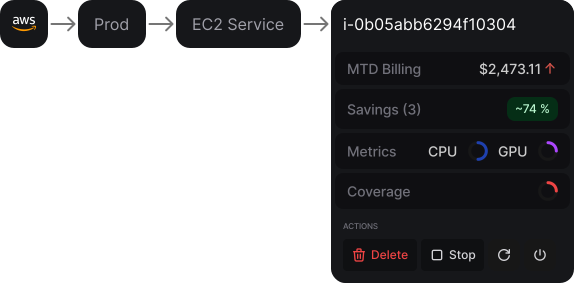
Progressive investigation
Move from accounts to individual resources. See costs, savings opportunities, and resource status in one place.
Problem
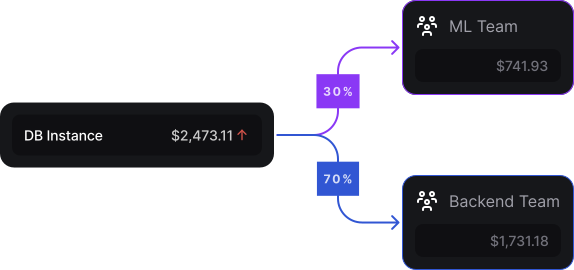
Unclear cost ownership
Solution
Rule-based cost allocation
Map shared infrastructure costs to teams, products, initiatives, and budgets without restructuring cloud environments.
Problem
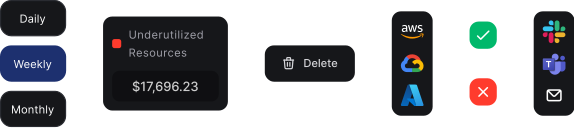
Unclear savings actions
Solution
Accountable action
Connect optimization opportunities to owners, workflows, alerts, and automation.
The Product
One workspace for the whole FinOps lifecycle
Some of the core features behind the unified FinOps experience.

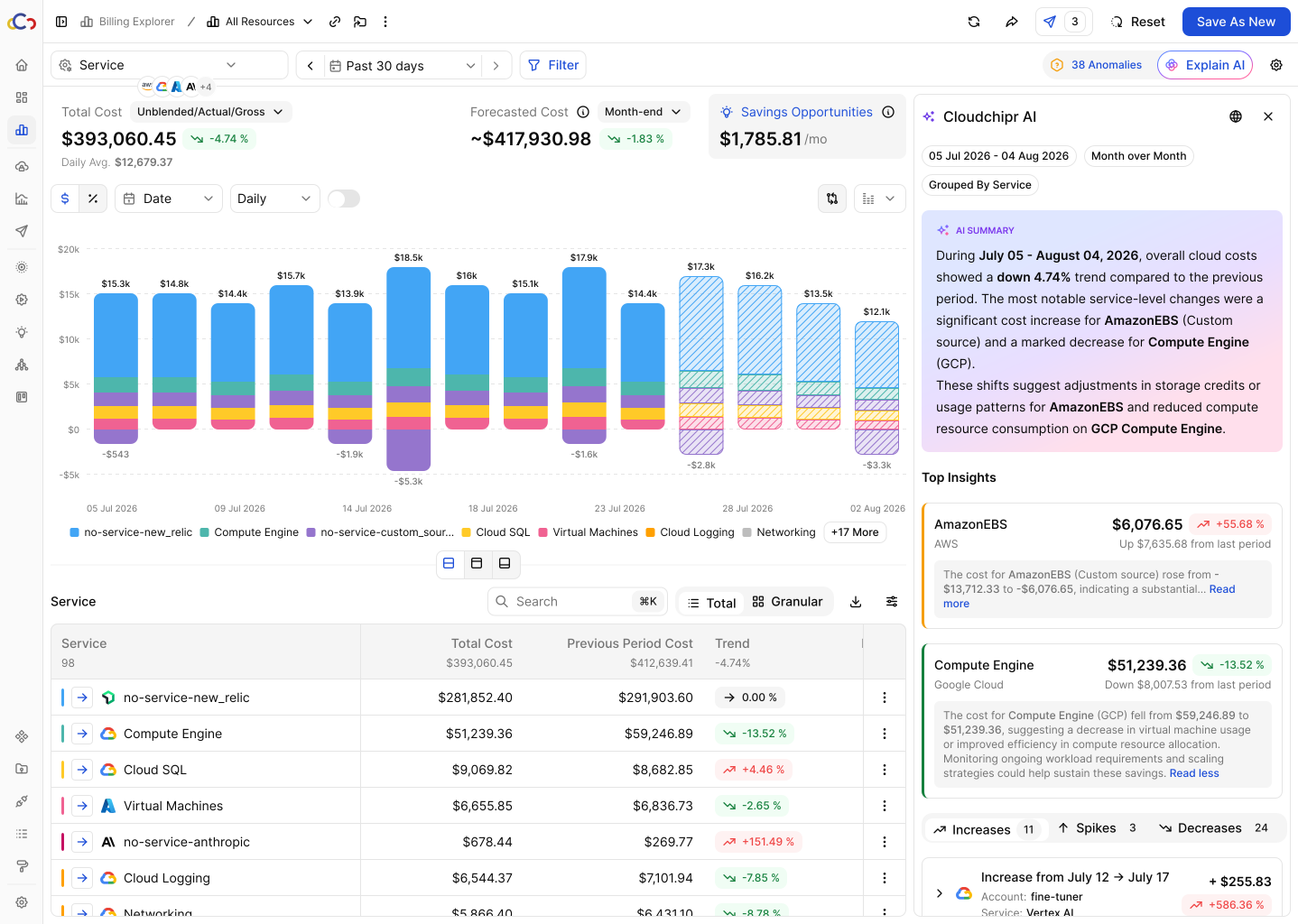
Investigating a cost change in one workspace
A flexible surface for investigating cloud costs, understanding changes, identifying responsible resources, and uncovering savings opportunities.

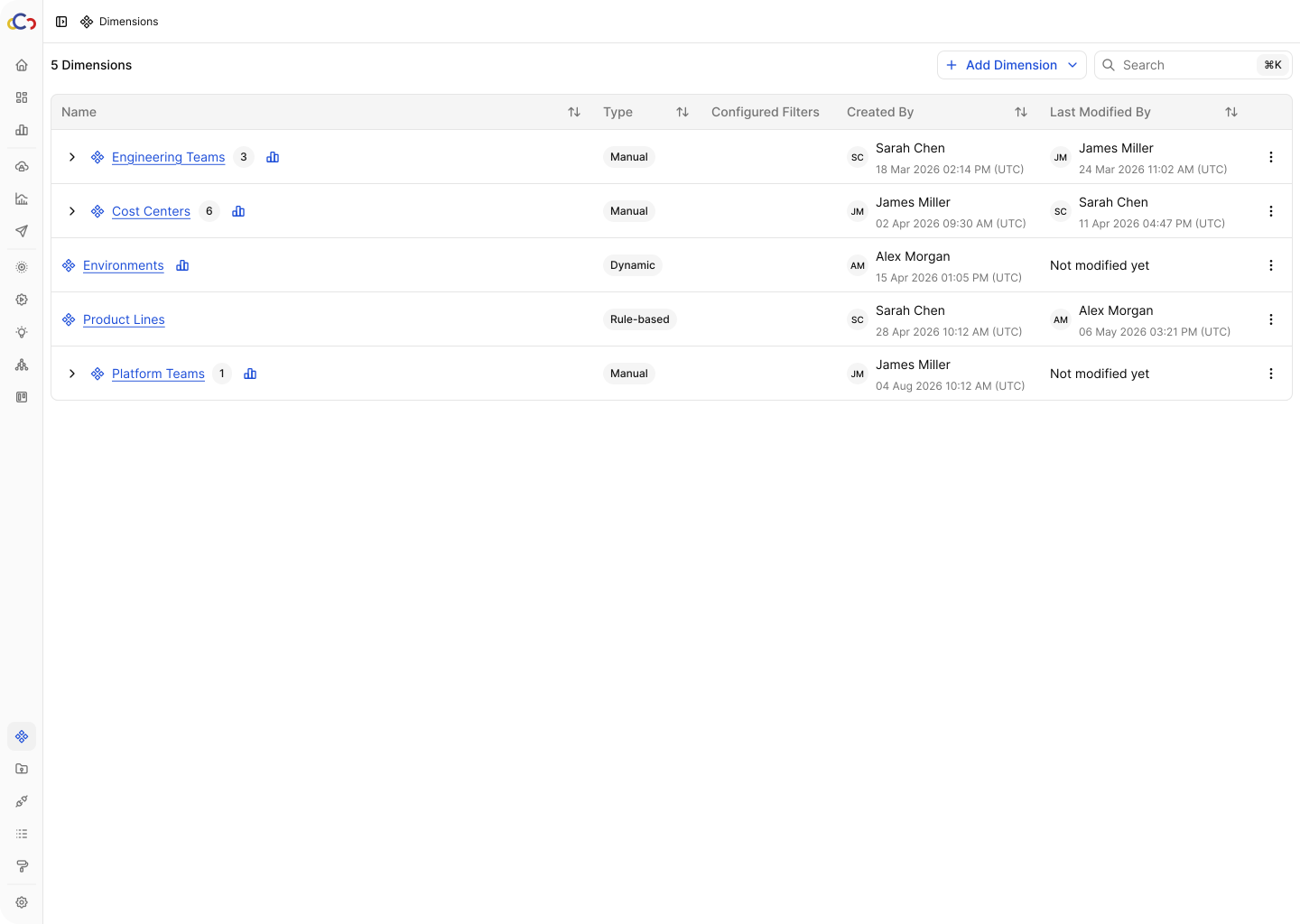
Costs grouped the way the business is organized
A system for organizing cloud costs by teams, products, environments, and business units using custom rules.

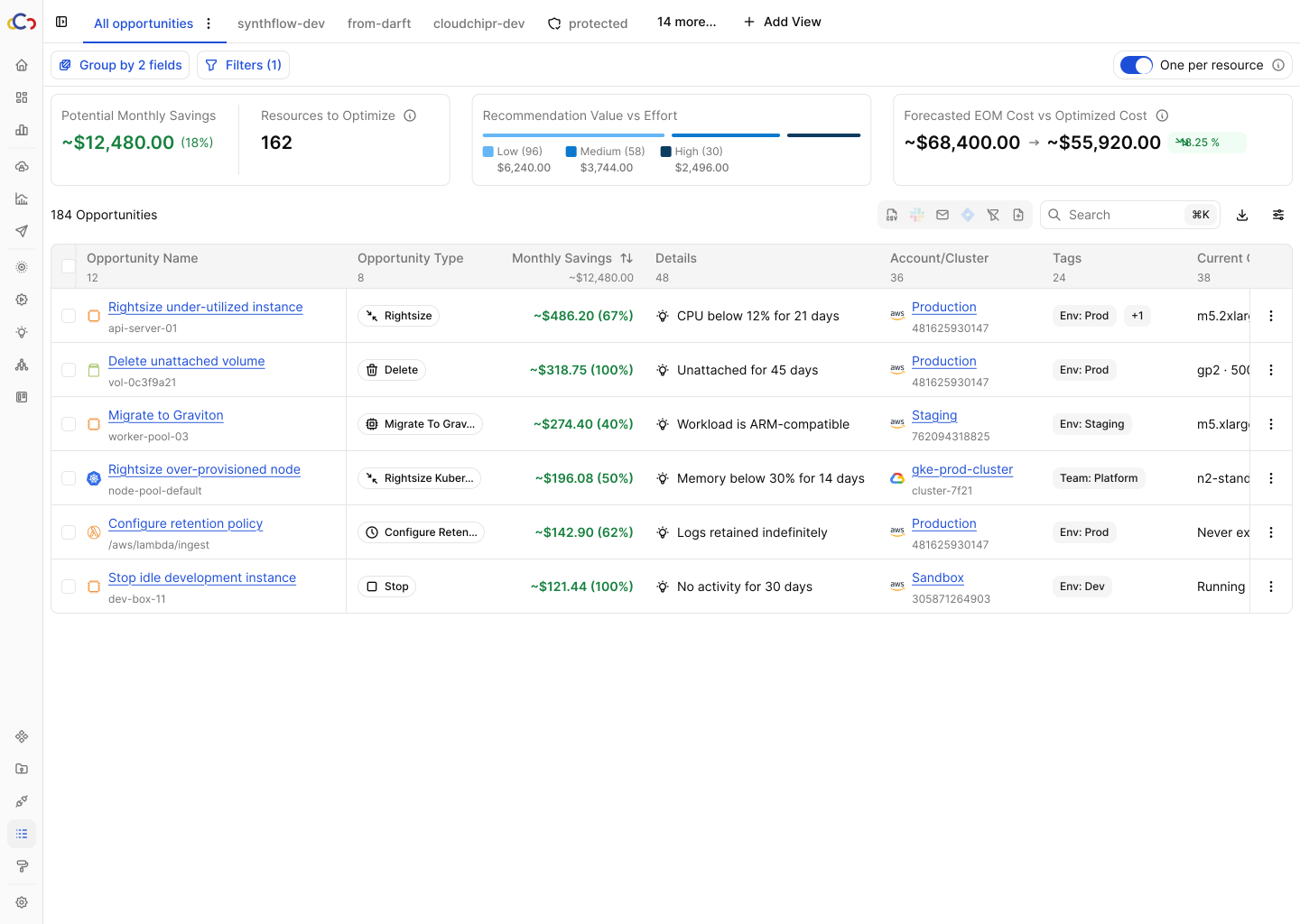
Recommendations that become trackable work
A connected workflow for identifying savings opportunities, evaluating their impact, and turning recommendations into trackable actions.

Cleanup that runs on a schedule
A flow for turning recurring cleanup into scheduled automations, routed to the people who approve them and the channels that report back.
Closing
Organizing complexity, not removing it
Designing Cloudchipr taught me that simplifying enterprise software rarely means removing complexity. It means organizing that complexity into workflows people can understand, trust, and act on.
As a founding designer, my role extended beyond individual features. I helped shape the product, establish interaction patterns, build the design system, and improve how the team moved from an idea to a tested and released experience.
My most important lesson was learning how to create structure without becoming a bottleneck. In a fast-moving environment, design leadership means making thoughtful decisions quickly, learning new skills when the team needs them, and helping others deliver stronger work.
What's next?
Want to talk about this case study, or have any questions for me? I'd be glad to chat about it.